
© Powered by SiteSpirit

 
logo.png

header_1.jpg


D-glide plain bearings

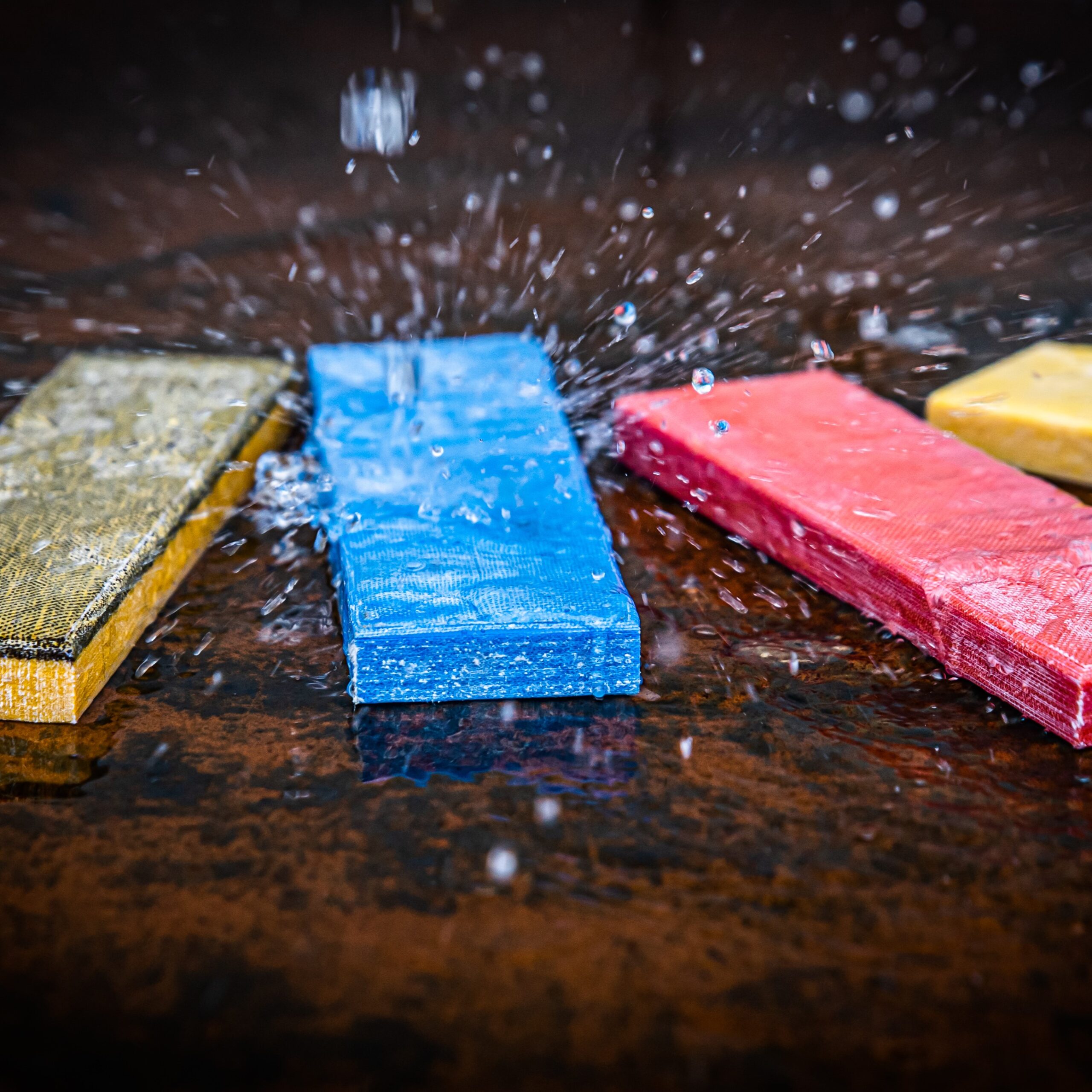
Verzamelfoto D-glide.jpg

DRIE-D is the manufacturer of the D-glide materials. The D-glide family is a series of modern composite bearing materials that all consist of a combination of modern synthetic fibres and resins. They are being produced according to the latest technology. The D-glide P, F and FC qualities contain, amongst other ingredients, PTFE. This has resulted in friction values for these materials that are on an unequalled low level, compared with other plastic bearing materials as well as with respect to conventional lubricated plain bearings. Also the 'stick-slip' behaviour, for practical applications a very important property, is better than of other plain bearings. A major advantage of composite bearings in general, is that they in most cases do not need lubrication, this usually means though, that concessions need to be made to the lifetime.


However, not with D-glide. Depending on the application, increases in lifetime compared with, for example, 'bearing bronze' of 2 to 10 times are feasible. Lubrication also does not have a bad influence and not only oils and greases, but almost all non-abrasive media can act as lubricant. D-glide P and F do not guide electricity which means that in corrosive environments corrosion of shafts and other surrounding metal parts is being prevented. Because the materials are virtually inert, reactions with, for example, food and cleaning substances almost never occur. Absorption of water and other fluids is negligible.


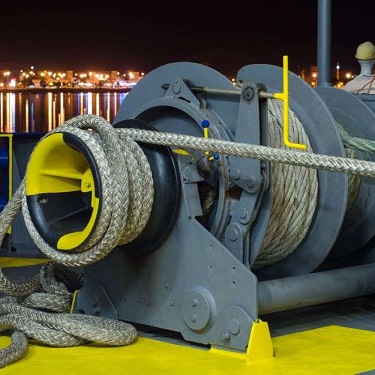
grote lager.jpg

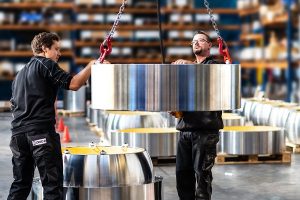
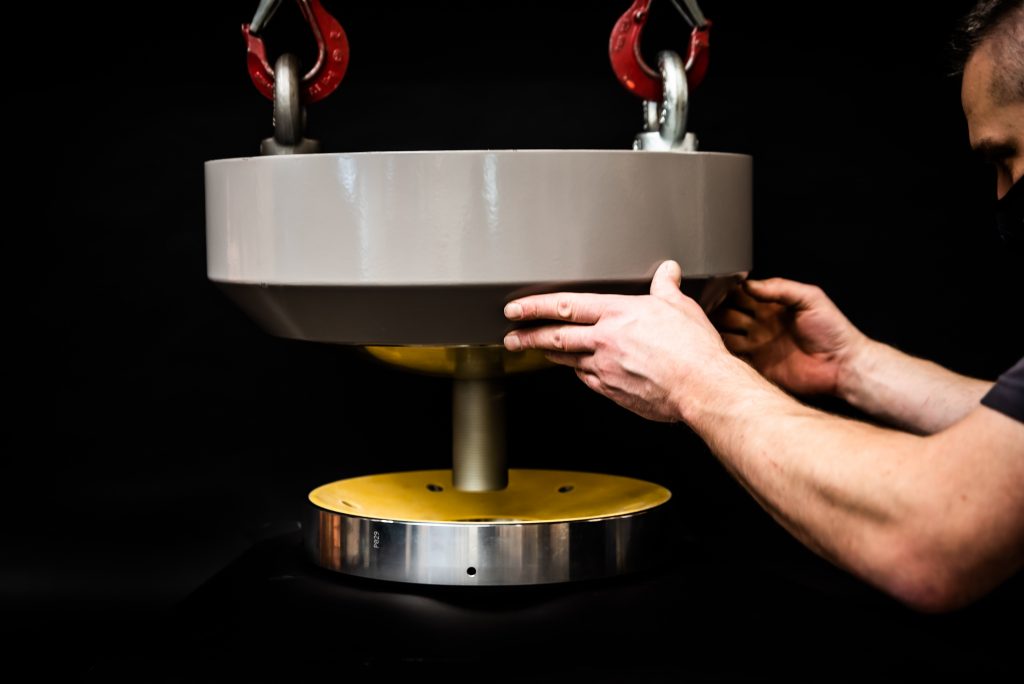
Besides the 4 standard qualities it is also possible to quickly and efficiently 'tailor make' a bearing quality, if for a specific application this leads to a better result. Thanks to the great strength of D-glide (up to more than 400 MPa), very high effective loads are possible. The load limit always depends on the application of a bearing but real loads of over 200 MPa are attainable. This is 10 times more than in a well-designed construction would be allowed on a bronze bearing! and of the D-glide qualities a non-creeping version is available.

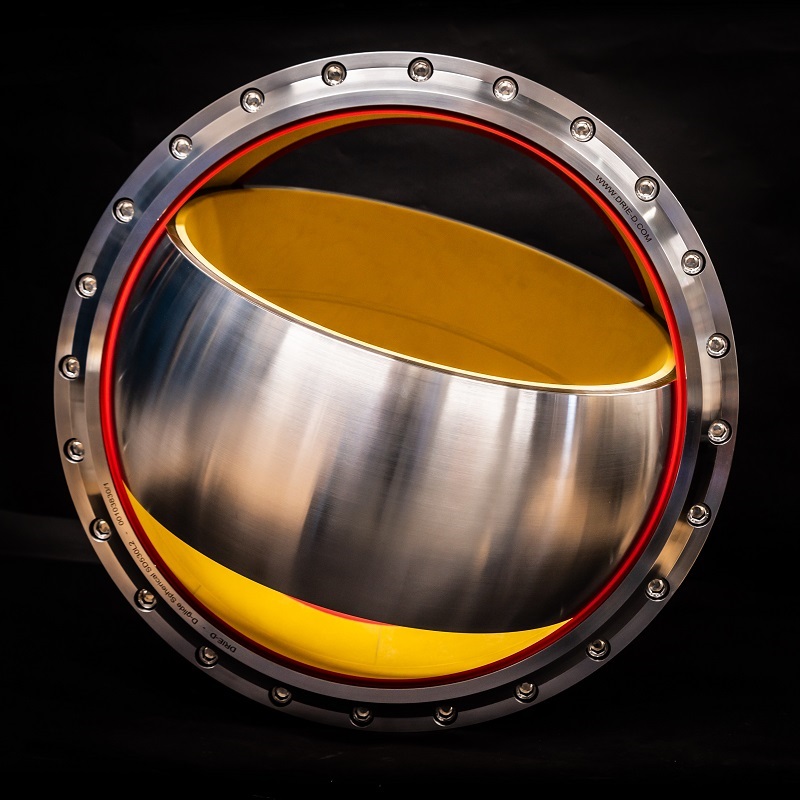
D-glide is delivered as finished bearing in all possible shapes and dimensions and as sheet and tube material. There also is a series of maintenance and corrosion free spherical bearings, the D-glide Sphericals. Thanks to this unique combination of properties the result with DRIE-D's D-glide bearings virtually always is a far better bearing construction or a bearing construction with a better price-performance ratio.


Main properties D-glide bearings

•    Maintenance free
•    High allowable loads
•    Low friction values
•    Low wear rates
•    Stable in all environments
•    Electrically insulating
•    Standard or tailor-made
•    Counter-face friendly
•    Exceeds the 'Powertech benchmark'


The 4 standard D-glide qualities

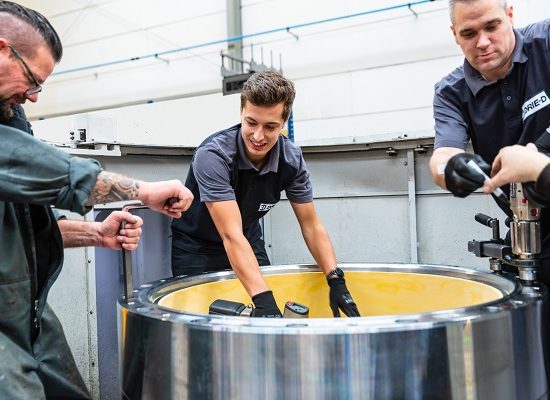
lagerblok-in-werkplaats.jpg

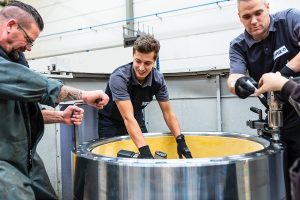
The 4 standard D-glide qualities De D-glide range consists of 4 standard qualities, D-glide P, F, FC en H. Within this range for most applications the optimal bearing material can be found. It is also possible to, quickly and efficiently, produce special qualities to optimally meet the requirements of specific applications. D-glide P is the base material of the range. The maximum loads are high, friction is low as are the wear rate and demands on the counter face materials. It is also available in a 'no-creep' version. D-glide P normally is blue but can also be produced in different colours. De cost price is the lowest and of all materials available it probably offers the best price-performance ratio. D-glide F is the superlative of D-glide P. It allows higher loads and more temperature. More important: friction is lower and the wear resistance even better. Also D-glide F is available in a 'no-creep' version. Both from research as well as from real application the conclusion can be drawn that D-glide F probably is the least wearing bearing material available. D-glide FC is a variety of D-glide F with which it shares the main mechanical properties. As all other D-glide qualities it is designed to be used without lubrication or any other kind of maintenance. D-glide FC has been developed to further reduce wear rates, especially in less than ideal circumstances. This includes many linear applications where the counter face conditions are not as well controlled as is usually the case in rotating motions. D-glide FC is even less sensitive than the other D-glide qualities to intrusion of foreign particles (for example sand or rust) in the contact surface. This gives the material a very constant long term behaviour; low wear rates and low and constant friction values, also in polluted environments. D-glide H does not have as good bearing properties as any of the other versions. However this material exceeds in its high temperature capability. Peak temperatures of up to 280°C are allowed and at 200°C the mechanical properties are still at a level of minimally 80% of the levels at room temperature. D-glide H is the only plain bearing material available for proper bearing constructions at these temperatures.


The main properties of the 4 standard D-glide qualities are summarised in the table below.

tabel-D-glide-FC.jpg

Remarks:

  • 1. The strength of a composite material is no objective value but depends on the shape of the test sample and the direction of the load. Given values apply to a flat sample of 50 x 50 x 5 mm and are determined at a temperature of 20°C.
  • 2. The strength of a composite material is no objective value but depends on the shape of the test sample and the direction of the load. Given values apply to a flat sample of 50 x 50 x 5 mm and are determined at a temperature of 20°C.
  • 3. Also this value applies for a standard test sample, for an average bearing bush for calculations a value of 50% of this number can be used.
  • 4. This is the maximum increase in wall thickness continuously immersed in water.
  • 5. This value applies to the expansion perpendicular to the normal fibre orientation, the expansion parallel to the fibres if less.
  • 6. The main chemical threat comes from concentrated acids and bases. With D-glide P and F also caution must be taken in contact with solvents such as 'Tri' and 'Tetra'
  • 7. D-glide P can also be made in different colours.
  • 8. This is the temperature the materials can withstand for a longer period of time without negative consequences, briefly higher temperatures are allowed. D-glide does not have a 'glass-temperature', there is no fixed bottom temperature, it does not get brittle. The stiffness does increase at lower temperatures.
  • 9. At these temperatures the main properties are at least at an 80% level of the values at 20 °C.
  • 10. The given lower limits indicate what is feasible under optimal conditions, it is advised to base calculations on the upper limits.
  • 11. This is an indication of the reduction in wall thickness as a function if the sliding distance. The given indication comes from comparisons with conventional and other plastic bearings in typical applications in good conditions.
  • 12. This is an indication of the reduction in wall thickness as a function of the sliding distance. The given indication comes from comparisons with conventional and other plastic bearings in typical applications in strongly polluted environments.
  • 13. At hardnesses lower than the given values the chances on wear increase. At higher sliding speeds and in abrasive environments a higher hardness is advised.
  • 14. For all plain bearings the lifetime is a function of the difference in hardness between bearing and counter face.
  • 15. The lower the roughness, the lower the friction and the initial wear.

DRIE-D bv       Kiotoweg 120       3047 BG Rotterdam, The Netherlands       tel: +31 (10) 462 07 00       fax: +31 (10) 462 07 07       E-mail: mail@drie-d.nl